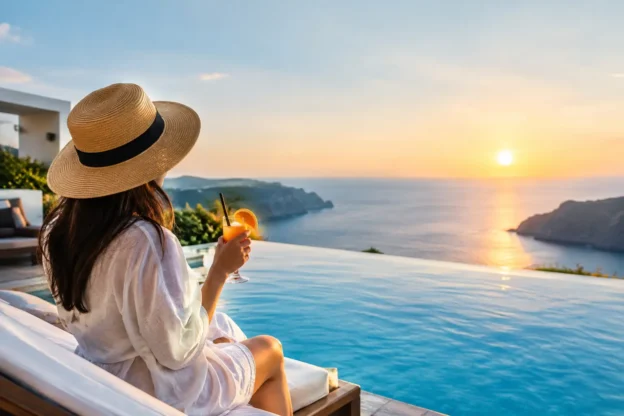
A reception area can tell guests where they are before anyone hands over a key. The best travel photography for hotels does more than fill a blank wall: it establishes a sense of place, supports the standard of the property and gives visitors a visual memory they may take away with them.
For hotels, serviced flats, restaurants and hospitality workplaces, the right image is rarely the most generic one. A well-chosen city view, coastline, historic street or local transport scene can make an interior feel considered without turning it into a themed set. The practical task is to source photographs that work at the required scale, suit the audience and can be licensed or printed without unnecessary complication.
What the best travel photography for hotels should do
Hotel imagery has a job to perform. It should be attractive at a glance, but it must also sit comfortably with the architecture, furnishings and daily movement of guests. A dramatic panoramic landscape may be ideal behind a reception desk, while a quieter architectural detail can suit a corridor or bedroom.
Start with the property’s relationship to its location. A central London hotel may benefit from documentary city scenes, recognisable landmarks viewed from an unusual angle, or period streetscapes that add character without repeating the view outside the window. A coastal property may use harbours, beaches, changing weather and local wildlife. For an airport hotel, carefully framed aviation, rail or urban transport photography can provide a relevant visual theme.
The strongest choice is not always the most famous view. Guests have seen standard landmark photographs many times. Images with perspective, atmosphere and clear geographical detail often feel more individual. They also give a property material that works in brochures, room directories, social posts and printed wall art when the licence permits.
Match the photograph to the space
A photograph can look excellent on a screen and still fail once it is enlarged or placed under hotel lighting. Consider viewing distance first. Large-format art in a lobby needs a clear subject, strong composition and sufficient resolution. Smaller framed images in bedrooms allow for more detail, such as architectural textures, street scenes or local seasonal moments.
Colour should support the interior rather than compete with it. Hotels with restrained finishes often have room for a bold sunset, bright festival scene or richly coloured European façade. A property with patterned carpets, statement furniture or coloured walls may need calmer landscapes, monochrome city images or a coordinated series with a limited palette.
Lighting matters as much as colour. Glossy prints can reflect downlights and windows, making a photograph difficult to appreciate. Matte finishes usually suit busy public spaces better, especially where guests approach the artwork from different angles. Before committing to a larger order, assess a proof in the actual location if possible.
There is also a practical distinction between public and private areas. Reception, bars and meeting rooms can carry more distinctive, conversation-starting images. Guest rooms generally benefit from scenes that are restful and broadly appealing. A highly dramatic image may be memorable in a lift lobby but distracting above a bed.
Use a consistent series, not repeated copies
A set of related photographs can create a stronger result than one image repeated throughout the building. Choose a common thread: London at dusk, British coastlines, European railway journeys, local architecture, seasonal landscapes or black-and-white transport scenes. Keep the framing, colour treatment or subject matter connected while allowing each image to have its own identity.
This approach is especially useful across corridors and multiple floors. It helps guests navigate a larger building and gives each level a recognisable character. A hotel near a major sporting venue, for example, might use carefully selected local sporting imagery in communal areas, provided the usage rights and any recognisable branding have been properly checked.
Choose travel imagery that feels credible
Hospitality buyers should be wary of photographs that could belong anywhere. A palm-lined promenade may look pleasant, but it will not strengthen a hotel’s identity if guests cannot connect it to a real destination or experience. Documentary-style travel photography has particular value because it records place, weather, movement and local detail.
Credibility does not mean every picture must be literal. An atmospheric image of rain on a London street, a row of seaside beach huts or a distant mountain railway can communicate location without relying on a postcard view. The best images have enough information to be specific, while leaving room for guests to form their own association.
For properties serving international visitors, recognisable UK and European scenes remain useful. They provide an immediate sense of arrival for guests on a short break, business trip or organised tour. For a more local audience, less obvious perspectives can be more effective. It depends on whether the hotel needs to introduce a destination or reflect familiarity with it.
Avoid visual clichés where possible. Overused images of landmarks may make a room feel generic unless they are unusually composed, historically relevant or exceptionally well printed. A smaller scene with strong light and genuine local character is often the better commercial choice.
Licensing and image quality need checking early
A hotel may need travel photography for wall displays, website pages, paid advertising, leaflets, booking communications or editorial content. These are not automatically the same use. Confirm the licence before downloading, printing or passing files to a designer.
Editorial imagery is often appropriate for publishing and factual context, but it may not be suitable for promotional use where people, private property, trademarks or protected events are prominent. Commercially cleared imagery is usually the safer route for advertising and brand-led marketing. If the intended use changes, check whether a further licence is required rather than assuming one purchase covers every channel.
File size is equally important. A web-ready file may be unsuitable for a two-metre canvas or large framed print. Ask for dimensions, resolution and the recommended maximum print size before production. Larger image sizes should be available when the original supports them, without treating a basic technical requirement as an avoidable add-on.
This is where a focused image library can save time. Prestige Pictures supplies travel, city, landscape, event and panoramic photography on a straightforward pay-per-image basis, with larger image sizes available on request where appropriate. That can suit hospitality buyers who need specific place-based imagery without taking on an ongoing subscription.
Check rights before using recognisable events and people
Travel photographs often include crowds, festivals, royal occasions, sports fixtures and public transport. Such images can have strong editorial value, but they require more care in commercial settings. A picture that is acceptable as a framed decorative print may still be unsuitable for an advertisement implying endorsement or affiliation.
Keep a record of the image reference, licence terms, purchase date and where the photograph is used. This is a simple safeguard when artwork is moved between properties, reused in campaigns or supplied to franchise partners. It also makes later replacement far easier.
Plan purchases around the hotel’s operating needs
Do not select wall art as a final styling decision after every other budget has been spent. Photography affects the guest’s first impression, the perceived quality of shared spaces and the visual consistency of marketing materials. Set aside a clear allowance for licensing, printing, framing, installation and future replacements.
For a single independent hotel, a small collection of high-quality local images may be enough. A group with several sites may need a central library that combines shared standards with location-specific work. In either case, buying only the images required offers more control than paying for a large volume of unused downloads.
Think about maintenance too. Public areas need prints that can be cleaned safely and frames that withstand regular contact. Choose formats that can be reordered if a print is damaged, and keep notes on frame sizes and finishes. Seasonal rotation can work well in lobbies and restaurants, but it should be planned rather than treated as a constant redesign exercise.
A practical selection process
Begin with the wall, not the search box. Measure the available area, note lighting conditions and decide whether the image needs to be calming, informative or visually dramatic. Then narrow the subject to a destination, region, activity or historical theme that supports the property.
Review shortlisted images at a realistic size. Check cropping, fine detail, colour balance and how the main subject sits within the frame. If several people are involved in the decision, compare images in the planned setting rather than discussing them only on a laptop.
Finally, purchase with the intended use written down. Specify whether the photograph is for a framed print, a website banner, a brochure or several approved channels. Clear instructions at this stage prevent licensing mistakes and last-minute artwork changes.
The right travel photograph gives guests a useful cue: this hotel belongs to a real place, and someone has paid attention to how that place is represented. Choose images with character, confirm the rights and print them properly. The result will continue working long after check-in.