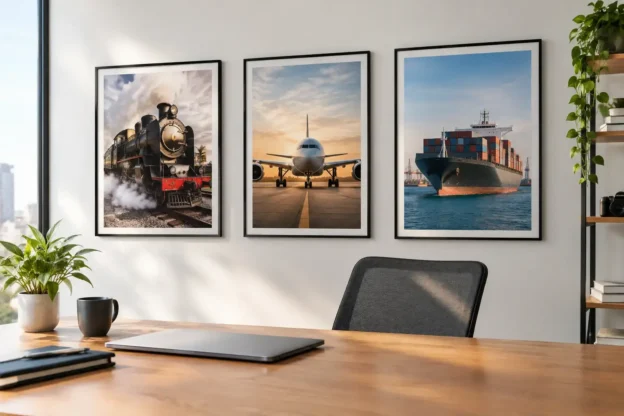
A London bus crossing Westminster, a steam locomotive leaving a plume over the platform, or a line of aircraft waiting at the gate can do more than fill an empty wall. Transport photography prints place movement, engineering and a sense of location in a room. They suit buyers who value a recognisable subject with real documentary character, rather than generic decorative imagery.
The strongest choice is rarely just the sharpest photograph. It is the image that works at the intended size, relates to the room and gives the viewer something to notice after the first glance. Whether the print is for a home office, hotel corridor, reception area or editorial-inspired interior, a few practical decisions will make the selection easier.
Choosing Transport Photography Prints by Subject
Transport is a broad subject, and that is its advantage. A railway image can feel nostalgic, industrial or highly contemporary depending on the train, location and composition. Aviation photography can convey scale and international travel, while classic cars, motorbikes and buses can establish a period or regional identity. Maritime images bring a different pace, from working ferries and harbour scenes to liners and sailing vessels.
Start with the story you want the photograph to carry. A close detail of a locomotive wheel or cockpit has a technical, focused feel. It works well in a study, workshop, transport business or compact space where the image will be viewed at close range. A wide photograph of a train travelling through open countryside, or aircraft against a dramatic sky, has more room to breathe and is generally better suited to a larger wall.
Location matters too. For UK interiors, familiar scenes often create an immediate connection: London Underground stations, red buses, heritage railways, coastal ports and airport approaches. International transport scenes can introduce contrast, particularly where the architecture, light or vehicle design clearly places the image in a different country.
A print does not need to show a famous vehicle to be effective. A well-observed street scene with a tram, lorry or railway platform may have greater long-term appeal because it records everyday travel and place. This is particularly useful for hospitality and workplace settings, where the artwork should reward repeat viewing without becoming visually overwhelming.
Match the Image to the Space
Before choosing a photograph, assess the wall rather than the catalogue thumbnail. Measure the available area and account for furniture, lighting, doorways and sightlines. A print over a desk, sofa or reception bench should be substantial enough to hold the space. One that is too small can look incidental, especially in a commercial interior.
A panoramic transport scene often suits a long wall. Railways, roads, bridges, runways and waterfronts naturally lend themselves to wide compositions because the route becomes part of the picture. Panoramic images can also make a narrow office or corridor feel less enclosed, provided there is enough viewing distance.
Portrait-format photography works differently. It can emphasise the height of a station roof, a ship’s funnel, a signal gantry or an aircraft tail. These prints are useful beside doorways, between windows or in pairs where a landscape image would feel compressed.
Consider the room’s existing colours. A black-and-white railway print is flexible and works with traditional, industrial and minimal interiors. Colour images need more judgement. The red of a Routemaster, the yellow of a vintage aircraft or the blue of a coastal ferry can be an intentional accent, but it should relate to the furnishings rather than compete with them. If a space already contains strong pattern and colour, a restrained image with a clear subject is usually the safer option.
Scale, Cropping and Print Finish
Print size changes how a photograph is read. At a smaller size, clean shapes and obvious subjects tend to perform best. A distant train in a complex station scene may lose its impact if printed too small, while a close-up of an engine badge or steering wheel can remain strong. At larger sizes, viewers can appreciate finer details, background activity and atmosphere.
Cropping should support the original composition, not simply force the image into a standard frame size. A railway scene may need its full sweep of tracks to make sense. An image of a classic car may depend on the shape of the bodywork and require more careful framing. Where a print will be displayed prominently, it is worth checking that the selected image is available at an appropriate resolution for the final dimensions.
Finish affects both appearance and practicality. A matte finish reduces reflections and is often preferable in offices, restaurants and rooms with large windows. Gloss can give colour and contrast extra punch, particularly in aviation and motorsport photographs, but it will show glare under direct lighting. Framed prints offer a formal, finished appearance, while unframed options allow buyers to match existing frames and interiors.
For commercial installations, consistency is often more useful than variety. A set of prints with the same finish, border treatment and frame style looks deliberate even when the subjects vary. A sequence of London transport, railway architecture and airport scenes can create a coherent display if the visual treatment remains consistent.
When a Print and an Image Licence Serve Different Needs
A physical print is intended to be displayed. An image licence is intended for publication, promotion or digital use. The same transport photograph may be suitable for both purposes, but the rights required are different.
If you need imagery for a brochure, website, magazine feature, presentation or social media campaign, obtain the appropriate licence before use. Do not assume that purchasing a wall print grants permission to reproduce the image in marketing materials. Equally, a licensed digital image is not automatically a ready-made print product for a client space.
This distinction is especially relevant to publishers, designers and venue operators. A railway photograph used in an editorial article may need a particular licence, while the same subject purchased as wall art is a straightforward decorative purchase. Planning the intended use at the outset avoids delays and ensures the correct product is selected.
Prestige Pictures provides both options: license an image for use in published or commercial work, or purchase it as a print for display. There is no need to commit to a subscription when a single, specific image is all that is required.
Building a Transport Print Collection
A single statement image can be enough for a home office or meeting room. Larger spaces often benefit from a small collection, but the selection should have a clear organising idea. It could be a place, such as London or the Scottish Highlands; a mode of travel, such as rail; or a period, such as mid-century motoring.
Avoid selecting every image at the same distance. A better arrangement combines an establishing scene with closer details. For example, a wide shot of a heritage railway can sit alongside a driver’s cab detail and a platform sign. The result feels curated rather than repetitive.
For a hospitality venue, think about how guests move through the space. A reception area may call for a bold, welcoming image with a clear landmark or striking vehicle. Corridors suit a sequence that can be enjoyed in passing. Meeting rooms benefit from images that are interesting but not distracting, often with quieter compositions and limited visual clutter.
Transport photography also works well where a business has a connection to travel, engineering, logistics, tourism or a particular region. The image need not be literal branding. A well-chosen local railway scene or port photograph can reinforce a sense of place more convincingly than standard corporate artwork.
Buy for Lasting Interest, Not Just Instant Recognition
The most successful transport photographs balance subject and atmosphere. A famous train, car or aircraft may attract attention, but the surrounding weather, architecture, light and human activity are what give a print lasting value. Look for images that still work when the viewer knows exactly what they are looking at.
Choose the photograph that fits the wall, the use and the people who will see it most often. A well-scaled print with a genuine connection to travel or place will continue to earn its position long after the room is finished.