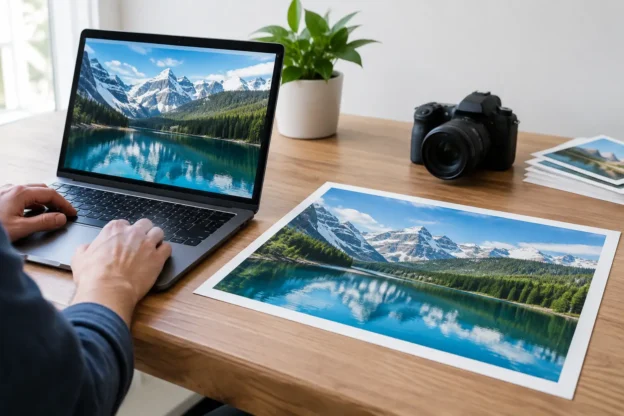
A striking panoramic view of London, a detailed wildlife photograph or a documentary image from a major sporting event can look excellent on screen at a modest size. Put that same image into a magazine spread, exhibition panel or hotel reception, and the file size becomes part of the brief. Buyers often ask: are larger stock images available when the download options shown do not match the final use?
Usually, yes. The useful question is not simply whether a bigger file exists, but whether it has enough native detail for the way it will be published or printed. A larger file should provide practical working room for cropping, layout and output without relying on artificial enlargement.
Are larger stock images available for commercial use?
Larger stock image files are commonly available where the original photograph has been captured at sufficient resolution. This is particularly relevant for professional photography of locations, events, transport, landscapes and architecture, where an image may be licensed for anything from a news feature to a printed display.
A web-sized file is designed for speed. It may be perfectly suitable for a homepage banner, social post or email campaign, but it will not necessarily hold up when used across a double-page spread or printed at wall-art scale. High-resolution files are intended for uses where fine texture, clean edges and detail matter.
At Prestige Pictures, larger image sizes can be requested without an additional charge. This gives buyers a straightforward route when the available option is not large enough for a planned layout, publication or print. There is no need to commit to a subscription simply to obtain the file needed for the job.
The right licence still matters. A large file does not automatically grant unlimited rights to reproduce it. Image size and usage permission are separate points: one concerns technical suitability, the other concerns where, how and for how long the image will be used.
Start with the finished size, not the download size
Before choosing an image, establish the physical or digital dimensions of the final piece. A photograph for a 1,200-pixel-wide website header has very different requirements from one intended for an A3 brochure, a pull-up display or a framed panoramic print.
Print resolution is often discussed in dots per inch, or DPI, although pixels per inch is the more useful measure when assessing a digital image. For close-viewed, high-quality print, 300 pixels per inch is a common target. A lower figure can still work for large displays viewed at a distance. A lobby print, for example, may look excellent at 150 pixels per inch because the viewer is not standing inches away from it.
To make the calculation, multiply the print dimensions in inches by the desired pixels per inch. An A4 page is roughly 8.3 by 11.7 inches. At 300 pixels per inch, the image should ideally be around 2,490 by 3,510 pixels. A full-page advert, a brochure cover or a print with a substantial crop may require more.
This is why pixel dimensions matter more than a label such as “large” or “extra large”. Those labels differ between suppliers. Ask for the actual dimensions if there is any doubt, particularly where a designer has specified trim, bleed or a precise placement within a layout.
Cropping changes the requirement
An image can have plenty of pixels and still become unsuitable if the composition needs heavy cropping. A landscape photograph used as a narrow banner may lose a large proportion of its original width or height. An editorial image may need space for headline text, a masthead or an advertiser’s copy.
Choose a file that leaves room to crop while retaining the important visual information. This is especially relevant for cityscapes, royal events, sports action and transport photography, where the subject may be positioned deliberately within a wider scene. A larger original creates more flexibility, but it cannot restore details that were never captured.
When a larger file is worth requesting
A larger stock image is sensible when the work will be printed, repurposed across several formats or passed to a designer who needs latitude in the layout. It is also worthwhile when the photograph is a central element rather than a small supporting image.
For publishers, this may mean a front cover, a double-page feature or a book illustration. For marketing teams, it may mean exhibition graphics, retail point-of-sale material, vehicle graphics or a campaign that runs across print and digital channels. For hospitality and interiors, it may mean a framed travel scene, panoramic landscape or city image intended to create impact at scale.
Not every project needs the maximum possible file. Ordering a very large image for a small online article can slow handling without improving the final result. Equally, using a small image because it is immediately available can create a visible compromise later. The efficient approach is to match the file to the job, then request more resolution where the output requires it.
Check the image before it reaches production
Resolution is not the only consideration. The quality of a large print also depends on focus, lighting, noise, compression and the age of the source image. Documentary archives may contain historically valuable photographs created with earlier equipment or under difficult event conditions. Their editorial value can be high even if they are not suitable for a vast exhibition graphic.
Review the preview at a useful size and consider the intended use. Fine detail in historic buildings, foliage, crowds, uniforms or vehicle signage may be important to the finished piece. If the image will be printed, ask whether the supplied file is the largest available original or a high-quality production copy.
Colour management also deserves attention. A file that appears bright on a backlit monitor can reproduce differently on paper, canvas or photographic print material. Printers may work in CMYK while image files are generally supplied in RGB. A competent print supplier can advise on the conversion, but it is sensible to retain detail in highlights and shadows from the start.
Avoid artificial enlargement where possible
Software can enlarge an image, and modern tools can produce convincing results in some circumstances. However, enlargement creates estimated pixels rather than genuine captured detail. It may be acceptable for a distant display, a simple background or a lightly textured subject. It is less dependable where faces, lettering, architecture or intricate natural detail must remain convincing.
A native larger file is generally the better choice. It gives the printer or designer more reliable information to work with and reduces the risk of soft edges, strange texture or visible artefacts. If enlargement is unavoidable, test a cropped section at final output size before approving the full production run.
Licensing and large-format printing
The intended use should always be clear before an image is licensed. Editorial use, promotional use, digital publication and decorative print sales can involve different rights and restrictions. A photograph of a public event may be suitable for editorial publishing but require further consideration for advertising or merchandise.
For decorative wall art, the distinction is particularly important. Buying a physical print for a home, office or venue is different from licensing an image to reproduce and sell multiple copies. If an image is being used as part of a commercial product, campaign or large installation, confirm that the selected licence covers that purpose.
Clear communication at this stage saves time. Provide the final dimensions, the format, whether cropping is planned and where the work will appear. This allows the most suitable file to be supplied and helps prevent a last-minute scramble when a printer requests a higher-resolution image.
A practical way to source the right size
Search by subject first: London, European travel, seasonal scenes, wildlife, military history, sport, transport or a specific event. Once the shortlist is in place, assess each image against the finished application rather than choosing solely on thumbnail appearance.
For a web article or small promotional item, the standard available size may be entirely adequate. For a magazine cover, retail display or framed panoramic print, request the larger file before the design is finalised. Build in room for cropping and check the licence alongside the technical specification.
The best image purchase is not necessarily the largest file available. It is the file that gives your publication, campaign or print the required quality without unnecessary cost or complication. Specify the end use early, ask for the dimensions you need, and let the photograph do its job properly.