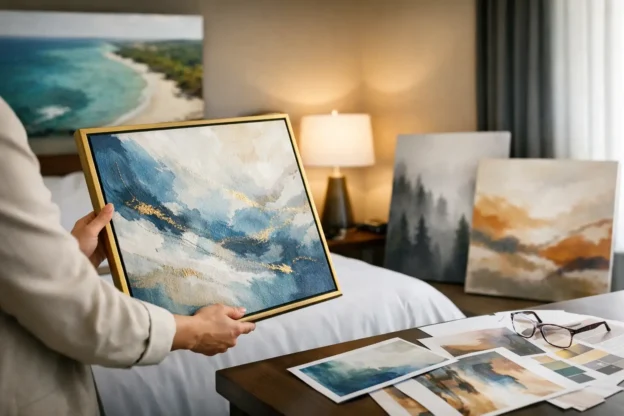
A guest may only spend a few seconds looking at a picture in a corridor, but they will notice immediately if it feels generic, poorly scaled or out of place. Knowing how to select hotel artwork is therefore less about filling blank walls and more about making every public and private space feel considered, recognisable and fit for purpose.
For independent hotels, serviced accommodation, resorts and hospitality groups, artwork also has a practical job. It supports the character of the property, gives guests visual reference points and creates a more polished setting for photographs, reviews and return visits. The best scheme is not necessarily the most expensive. It is the one that suits the building, the audience and the operational realities of the site.
Start with the property’s story
Before reviewing image collections or choosing frame finishes, define what the hotel is trying to say. A converted city townhouse, a coastal retreat and an airport hotel may all offer comfortable rooms, but their artwork should not communicate the same thing.
Look at the location, architecture, history and guest mix. A hotel near a railway terminus may use strong transport photography or archival city scenes. A country property may suit local landscapes, wildlife or seasonal images. A central London venue can use familiar landmarks, but should avoid turning every wall into a postcard display. Less obvious views, street details and documentary images often give a scheme more authority.
The aim is a clear visual thread rather than repetition. If the lobby features large-scale black-and-white local photography, bedrooms might use quieter colour landscapes from the same region. The connection remains, while each area receives the mood it needs.
Match artwork to the room’s purpose
Artwork should work at the pace of the space. Guests move through a lobby, wait in a lift area and rest in a bedroom. Treating each wall alike is a common and costly mistake.
Public areas need a strong first impression
Reception areas, lounges, restaurants and meeting spaces can take bolder work. Large panoramas, architectural images, city scenes and event photography give people something to look at while they arrive, meet or wait. These spaces also tend to have higher ceilings and longer viewing distances, so small prints can disappear.
Consider sightlines from the entrance, reception desk and main seating areas. A single oversized image may be more effective than several unrelated prints. In a restaurant, choose imagery that complements rather than competes with the food, lighting and table settings. Highly detailed work can feel busy in a space already full of activity.
Bedrooms need calm, not clutter
In bedrooms, art is viewed at close range and alongside fabrics, furniture and lighting. Choose images with a clear focal point and enough visual calm to support rest. Landscapes, coastal scenes, gentle architectural studies and restrained local subjects generally work well.
Avoid placing very dramatic, high-contrast images directly above the bed unless the room concept calls for it. They can dominate a small room and make a standard bedroom feel less settled. A pair of medium-sized prints beside a seating area, or one carefully scaled piece above a desk, may offer a better result.
Corridors need consistency and orientation
Corridors are ideal for a series. Repeated frame sizes and a consistent image treatment make a long route feel intentional. A sequence of local views, transport subjects, historic details or seasonal photography can also assist wayfinding, particularly on larger properties.
Keep the pacing practical. Artwork placed too close together can feel like a gallery wall rather than part of a hotel. Leave enough clear wall space for each image to register, and make sure the scheme can withstand luggage traffic, cleaning equipment and frequent guest movement.
Use local relevance without becoming predictable
Place-based photography is valuable because it gives guests a sense of where they are. For business travellers, it can make an otherwise functional stay more memorable. For leisure guests, it reinforces the purpose of the visit.
That does not mean every image must show a famous attraction. A hotel in Edinburgh does not need the castle in every room, and a London property does not need a red bus on every floor. Look for images that show the character of the destination: markets, bridges, coastlines, parks, changing weather, street architecture, sporting occasions or recognisable regional details.
This is where a specialist image archive can be more useful than a broad, anonymous interiors catalogue. Collections organised by location, event and subject make it easier to build a coherent selection around a property. Prestige Pictures, for example, offers documentary-style photography alongside wall art prints, allowing buyers to source images with a clear connection to the UK, Europe and wider travel destinations.
Get scale, framing and placement right
An excellent photograph will still look wrong if its size is misjudged. Scale should be planned against the wall, not chosen from a thumbnail. Measure usable wall width and height, allowing for lamps, switches, furniture, signage and fire safety equipment.
As a working rule, art above a sofa, bedhead or console should occupy roughly two-thirds to three-quarters of the furniture width. The centre of a single print is usually most comfortable at around eye level, although higher ceilings and public areas may require adjustment. In guest rooms, placement should relate to furniture rather than float in the middle of an empty wall.
Frames are part of the specification. Black, white, natural timber and brushed metal each create a different effect. A contemporary business hotel may need clean, consistent black frames. A heritage property may benefit from warmer timber, provided it does not make the scheme look dated. Use glazing suitable for the location. Anti-reflective finishes help where there is strong natural light, while durable acrylic may be the sensible option in high-traffic spaces.
How to select hotel artwork within budget
Set the budget after agreeing the visual direction, not before. If purchasing begins with the lowest available unit price, the result is often a mixture of sizes, subjects and frame styles that costs more to correct later.
Separate the budget into image rights or print purchase, production, framing, delivery, installation and replacements. Hospitality walls receive wear. Keeping a small number of spare prints, or retaining accurate order details for reprints, reduces disruption when a piece is damaged.
There are sensible places to concentrate spend. Invest in the arrival experience, signature suites, restaurant focal points and meeting rooms where guests spend time or take photographs. Use a simpler, repeatable format in corridors and standard bedrooms. This is not cutting corners. It is allocating budget according to visibility and commercial value.
Original art can create distinction, but it may be difficult to replace and expensive to deploy at scale. Licensed photography and editioned print programmes offer greater consistency, easier replacement and access to a wider range of locations and subjects. The right choice depends on the property’s position, available budget and number of rooms.
Check rights and buying terms before installation
Artwork for a hotel is a commercial use, so rights should be confirmed before an image is printed, displayed in marketing material or reused elsewhere. Do not assume that downloading a stock image, buying a consumer print or finding an image online gives permission for all of these uses.
Ask clear questions about the intended application. Is the image being bought as a finished wall art print for display only? Is the hotel commissioning its own print production? Will the image appear on the website, booking platforms, brochures or social channels? These uses may require different permissions.
Also check whether the selected image has any limitations relating to people, private property, trademarks or editorial use. Documentary and event imagery can be highly effective in hospitality settings, but its permitted use must match the project. Straightforward, pay-per-image sourcing can be particularly useful for buyers who need only a defined number of images rather than an ongoing subscription.