A wide panoramic of the London skyline, a close wildlife portrait or a sunlit coastal scene can look entirely different once it is printed. The choice between canvas prints or framed photography is not simply about budget. It affects the image’s detail, its visual weight on the wall, and how well it works with the room around it.
For homes, offices, hospitality spaces and reception areas, the right format should support both the photograph and the setting. A busy city image may benefit from a clean frame that preserves architectural detail. A large landscape may need canvas to create impact without making the wall feel over-designed.
Canvas prints or framed photography: the main difference
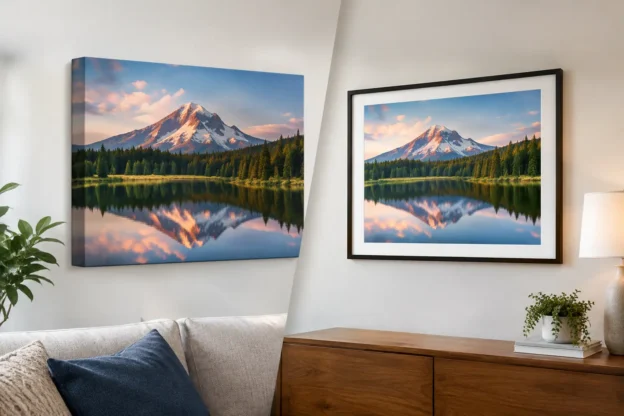
A canvas print is produced on a textured fabric canvas and stretched over a wooden frame. The image usually wraps around the sides, creating a ready-to-hang piece with depth. It has a softer, more painterly finish than photographic paper and does not usually require glazing.
Framed photography is printed on photographic paper, then mounted and placed behind glazing within a frame. This format gives the image a crisp, finished presentation and offers more choice over frame material, colour and mount. It can feel more formal, but it is not limited to traditional interiors.
Neither option is automatically better. The practical decision is based on the photograph, viewing distance, room conditions and the look you need to achieve.
When canvas is the practical choice
Canvas is often effective for large wall art. It has physical presence without the added cost and weight of a large glazed frame, making it useful for broad landscapes, travel views, coastal scenes and panoramic photography. A large print of the Scottish Highlands, a European city at dusk or an Australian beach can carry a room without requiring elaborate finishing.
The canvas surface softens very fine detail slightly. For many scenic images, that is an advantage rather than a limitation. Texture can add warmth to skies, water, foliage and clouds, while the lack of reflective glass makes canvas easier to view opposite windows or under strong overhead lighting.
Canvas also works well where a relaxed, contemporary finish is required. It suits living rooms, informal meeting spaces, cafés and holiday accommodation. Because the image wraps around the stretcher bars, the print needs enough space at the edge to tolerate the crop. Photographs with a key subject placed tightly against the border may be less suitable unless the print is prepared with mirrored or extended edges.
A canvas print is usually straightforward to hang, but it still needs a sound fixing. Larger sizes are lighter than a framed print of similar dimensions, yet they should not be treated as weightless. In high-traffic commercial spaces, select a position where corners are unlikely to be knocked.
When framed photography gives a better result
Framed photography is the stronger choice when image sharpness, fine lines or a controlled presentation matter most. Architectural images, transport photography, editorial scenes, sports action and formal event images often benefit from the clarity of photographic paper. Details such as building façades, train liveries, military uniforms or crowd scenes remain more precise when viewed close up.
A frame also gives you control over the final appearance. A narrow black frame can suit modern offices and monochrome city photography. Natural wood can make rural, wildlife and heritage images feel warmer. A white mount creates breathing room around the image and can make a smaller print appear more considered on a large wall.
For venues that need a consistent scheme, framing provides repeatable structure. A hotel corridor, office suite or restaurant can use matching frames across images from different locations and subjects. The photographs may vary, but the presentation remains organised.
There are trade-offs. Glazing can reflect light, particularly in rooms with large windows or spotlights. Framed prints are also heavier, and very large pieces require more careful handling and wall fixings. If the print will be displayed in a humid bathroom, pool area or poorly ventilated space, standard framing is not always the sensible choice. Seek materials suited to the environment rather than treating all framed work as interchangeable.
Match the finish to the photograph
Start with the subject rather than the décor trend. This prevents a good photograph being forced into a format that does not suit it.
Canvas generally complements images with broad colour, atmosphere and depth. Landscapes, seascapes, seasonal scenes and travel photography often work well because they are frequently viewed from several steps back. The canvas texture is less noticeable at that distance, while the scale and colour make their contribution.
Framed photography is more useful for documentary-style images that reward close viewing. A royal event, a historic London street scene, a classic vehicle or a detailed wildlife image may contain smaller moments that canvas can soften. The clean edge of a frame directs attention towards those details.
Black-and-white photography can work in either format, but the intended mood matters. Canvas can give a grainy, expressive image a gallery-like presence. A black frame and white mount can make the same image feel more editorial and precise. For colour photography, consider whether the room needs a softened statement piece or an image with cleaner contrast.
Size, wall space and viewing distance
A print that looks impressive on a product page can disappear once it reaches a large wall. Before choosing a format, measure the available space and mark out the proposed size with low-tack tape or paper. This is particularly useful above a sofa, bed, sideboard or reception desk.
Large canvas prints are often effective as a single focal point. Their depth helps fill an empty wall, and they do not need a mount or substantial frame to look complete. Panoramic images are especially useful over wide furniture, provided the image has enough resolution for the selected size.
Framed photography can be equally effective at a large scale, but it may cost more as dimensions increase. It is often the more flexible option for grouped displays. Three or more related images, such as London landmarks, British wildlife or seasonal scenes, can be framed consistently to create a clear series. Keep the spacing between frames even and let the images share a subject, colour treatment or location.
Viewing distance should guide detail. If visitors will see the print mainly from across a lobby or room, canvas is frequently sufficient. If they will stand close to it in a corridor, waiting area or home office, framed photographic paper may make more sense.
Cost is more than the print price
Canvas can offer good value at larger sizes because the finished piece does not need separate mounting, glazing and framing. It is often the economical route for decorative wall art where scale is the priority.
Framed photography involves more components and usually a higher finished cost, especially with premium frames, mounts or larger sizes. That additional spend can be justified where presentation is part of the brief. A client-facing office, a boutique hotel or a carefully designed home may benefit from the polish and durability of a well-framed print.
Do not select the smallest size simply to reduce cost. A print that is too small for the wall often looks temporary, regardless of its quality. It is usually better to choose one appropriately scaled piece than several undersized prints without a clear arrangement.
Care, light and long-term display
Both formats should be kept away from persistent direct sunlight where possible. Strong UV exposure can affect printed colour over time, particularly in south-facing rooms. Positioning matters as much as the product specification.
Canvas should be dusted gently with a dry, soft cloth. Avoid sprays, household cleaners and excessive moisture. Do not press hard on the surface, as canvas can dent or loosen if mishandled.
Framed photography should be cleaned by wiping the glazing carefully with a suitable cloth, avoiding liquid around the frame edges. If condensation appears behind the glazing, move the piece away from damp conditions. Prints intended for kitchens, bathrooms or other challenging environments need extra consideration before purchase.
Choosing images for print with confidence
The quality of the original image determines how well a large print will reproduce. Look for a file that is suitable for the intended dimensions, particularly for wide panoramas and detailed scenes. If a larger image file is needed for print production, request it before finalising the order rather than accepting a compromised result.
Prestige Pictures offers location-led, editorial and scenic photography that can be licensed for publishing or selected as wall art, allowing buyers to source imagery according to the job. A cityscape used in a brochure may later suit a boardroom wall, but licensing and physical print requirements should always be treated as separate purchase decisions.
Choose canvas when the photograph needs scale, texture and low-reflection presentation. Choose framed photography when detail, a formal finish or a coordinated interior scheme takes priority. The best result is the one that gives the image enough room to do its job on the wall.