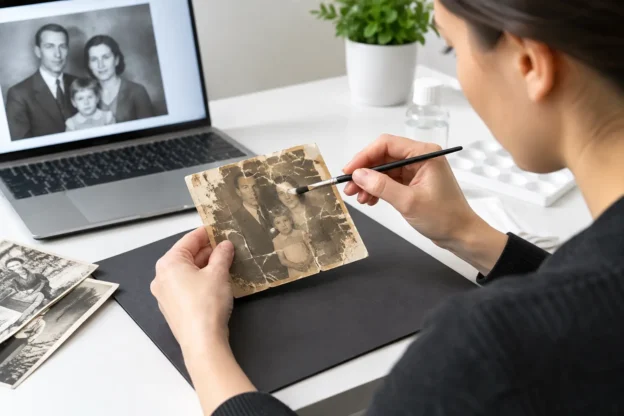
A photograph does not become free to use simply because it is old, unattributed or widely shared online. Knowing how to clear historical photographs means establishing who controls the relevant rights, what your intended use requires, and whether the evidence supports a licence or a documented risk decision.
For publishers, designers and marketing teams, this work should begin before a layout is approved or a campaign is priced. A compelling archive image may be ideal for a book, exhibition panel, article, advert or wall display, but replacing it late in production can be costly. Clear the image first, then build it into the project.
Start with the photograph, not the caption
Record everything supplied with the image: the filename, source, caption, date, photographer name, agency or collection name, reference number and any wording shown on the back or mount. Keep a copy of the version you intend to use. Small differences matter: a cropped press image, a later print and a digitally restored scan may each have a different source trail.
Then identify the work as precisely as possible. Ask when it was taken, who created it, whether it was published during the photographer’s lifetime, and where it was first published. Do not rely on a date in a search result or a social media post. Those descriptions are often repeated from an earlier, unverified source.
If an archive, library, estate, newspaper or picture agency supplies the photograph, request its licence terms in writing. A reputable supplier should be able to state the permitted media, territory, duration, circulation or audience limits, and whether the image may be cropped, edited, shared with a client or used in paid promotion.
Age is not a clearance decision
In the UK, photographs are generally protected as artistic works. For many modern photographs, copyright lasts for the life of the photographer plus 70 years. That is a useful starting point, not a shortcut. Older photographs can involve transitional rules, anonymous authorship, posthumous publication and other facts that affect the calculation.
A photograph from the 1930s may therefore still be protected if its photographer died within the relevant period. Conversely, a much older image may be out of copyright, but that does not automatically give you a right to use a high-resolution scan supplied by a collection on whatever terms you choose.
There can also be a 25-year publication right where a previously unpublished public-domain work has first been lawfully published. Crown copyright, commissioned material and foreign works can require separate consideration. If the image will carry a significant commercial value, be used at scale or form part of a long-running product, seek specialist legal advice rather than making a decision from a general copyright table.
Separate copyright from ownership of the object
The owner of a Victorian print, negative or album is not necessarily the copyright owner. Buying an original photograph at auction usually transfers the physical item, not the intellectual property rights in it. Equally, a museum or archive may own the print and control access to it without owning the original copyright.
This distinction is central to historical image clearance. You may need permission to reproduce the collection’s scan under its access terms, permission from the photographer’s estate if copyright remains active, or both. A collection may charge a reproduction fee even where it does not claim copyright in the underlying image. Read the terms rather than assuming the label “public domain” settles every issue.
Faithful digitisation of an out-of-copyright photograph will not always create a new copyright work in its own right. However, the archive may still impose contractual conditions when it provides the file, especially at publication quality. The practical route is usually simple: obtain the image from a recognised supplier and secure a licence that clearly matches the intended use.
How to clear historical photographs for your project
First, define the use before approaching a rights holder. “Website use” is too vague. State whether the image is for an editorial article, a book cover, a museum display, social channels, a paid advertisement, product packaging, a television programme or a fine-art print. Include territory, language editions, print run, campaign duration and whether the image will be sublicensed to a client.
Next, trace the rights chain. Search the photographer’s name, the publication in which the image first appeared, agency stamps, collection records and estate information. For press photography, the originating newspaper, syndication agency or picture library may be the fastest route. For family or local-history material, a donor agreement or estate representative may hold the answer.
When you contact a supplier, ask direct questions. Confirm that it can license the required use, whether the licence is exclusive or non-exclusive, whether digital promotion is included, and whether enlargement, restoration or cropping is permitted. Establish the required credit line and retain the invoice, licence and correspondence with the project records.
Finally, make the clearance decision against the evidence. A clear licence is preferable to a hopeful assumption. Where copyright has expired, retain the research that supports the conclusion, including creator dates and publication details. This gives editors, clients and future colleagues a usable audit trail.
Editorial use and commercial promotion are different
An image used to illustrate a factual article, documentary or historical book is not automatically risk-free, but its use may raise fewer issues than using the same image to sell a product. Advertising can introduce additional concerns around endorsement, passing off, trade marks, privacy and reputation.
Be particularly careful with recognisable people. Copyright clearance deals with the photograph as a work. It does not necessarily deal with personality rights, privacy claims or the suggestion that a person, organisation or estate supports your campaign. The facts, location and context all matter.
For example, an archive image of a historic sporting event might be suitable for editorial publication under a picture licence. Using it on merchandise, packaging or a sponsored social advert can require broader rights and may be declined altogether. Do not assume that a licence for a magazine page extends to posters, greetings cards or decorative wall art.
Do not overlook alterations, captions and credit
Historical photographs are often restored to remove scratches, improve contrast or repair damage. Technical correction may be permitted, but substantial recolouring, compositing or AI-generated additions can change the meaning of documentary material and breach licence terms. It can also create editorial accuracy problems.
Use accurate captions. If the date, location or identity of a subject is uncertain, say so rather than presenting a guess as fact. This matters especially for royal events, military subjects, public incidents and images carrying political or cultural sensitivity.
Credit requirements are not optional housekeeping. A licence may require a named photographer, collection, estate or archive reference. Build the credit into the page design, metadata or caption workflow from the beginning. It is much harder to correct once artwork has been approved.
When the photographer cannot be found
An image with no obvious creator is often described as an orphan work. That description does not mean it is free to use. Carry out and record a diligent search: inspect the image, check known publications and collections, search relevant agency records, and contact likely rights holders where practical.
The UK has an orphan works licensing scheme for certain uses, but it is not a general permission to take any uncredited image from the internet. It involves a specific application and an assessed diligent search. It may be useful where the image is genuinely important and no conventional licence can be obtained.
If the risk remains uncertain, choose another image. A well-documented alternative from a specialist archive is usually faster, safer and easier to budget than an unresolved rights claim. Prestige Pictures, for example, supplies licensable documentary and location-led imagery on a pay-per-image basis, which can simplify sourcing where a clear usage route is required.
Treat historical image clearance as part of commissioning, not an administrative task after the creative choice has been made. The strongest archive image is the one you can publish confidently, credit correctly and use within terms that are clear to everyone involved.