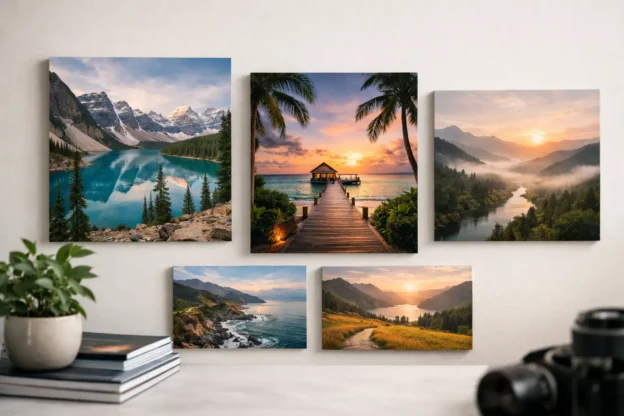
A photograph of a familiar coastline, a London skyline at first light or a wide mountain view can do more than fill an empty wall. It gives a room a sense of place. The question of where to buy scenic wall prints is therefore not only about finding an attractive image. It is about finding photography with the right subject, scale, print quality and buying terms for the space you are furnishing.
For a home, that may mean a landscape that feels personal rather than generic. For an office, hotel, restaurant or reception area, it may mean location-led artwork that supports the setting and still looks credible at a larger size. The best source depends on what you need, but the buying process should be straightforward: choose the subject, check the image, select the print option and order without a subscription or unnecessary restrictions.
Where to buy scenic wall prints that feel specific
Large homeware retailers and marketplaces offer plenty of ready-made wall art. They can be useful when price and speed matter most, particularly for a standard-sized framed print. The trade-off is repetition. The same heavily edited beach, forest or city image may appear in thousands of homes, rental properties and workplaces.
Photography libraries and specialist print suppliers are often a stronger choice when the location matters. They typically hold deeper archives of cities, landscapes, coastlines, landmarks, transport, wildlife and seasonal scenes. That gives buyers more control over the view itself: a particular part of London, a less familiar European street scene, an Australian coastline, or a panoramic landscape with room to breathe.
This matters especially for commercial interiors. A hotel near the coast may want regional imagery rather than a generic tropical beach. A London office may prefer documentary-style views of the capital. A business with international clients can use scenes that reflect its markets, heritage or working locations. Specific photography tends to look considered because it has a reason to be on the wall.
Prestige Pictures is one option for buyers who want scenic photography drawn from a broad archive of UK, European and international subjects, available as wall art as well as for image licensing. The practical advantage is choice across travel, landscape, city, event and themed imagery without having to commit to a membership.
Start with the room, not the photograph
A scenic print can look excellent online and still be wrong for the wall. Before browsing galleries, decide what the room needs from the image.
A compact hallway often benefits from a vertical city view, woodland path or architectural detail. A wide wall above a sofa, bed or reception desk usually suits a panoramic coastline, skyline or open landscape. In a meeting room, a calmer scene with a clear horizon can provide visual interest without becoming a distraction. For hospitality spaces, a connected group of prints may work better than one large piece, particularly along corridors or across several guest rooms.
Also consider viewing distance. Fine architectural details and busy street scenes reward closer viewing. Broad landscapes, skies and coastal images read well from across a room. If people will see the print mainly from several metres away, choose a composition with a strong overall shape rather than relying on small details.
Colour deserves the same practical attention. You do not need to match every cushion or paint shade, but the image should sit comfortably with the existing scheme. Muted winter scenes, black-and-white city photography and soft coastal colours are flexible choices for professional settings. Strong sunset tones, autumn colour or vivid blue water can make a more deliberate statement in a home, restaurant or leisure venue.
Check the image before choosing a size
Not every image is suitable for every print dimension. A scenic photograph needs enough resolution for the intended output, particularly when it will be enlarged for a lobby, boardroom or feature wall. Ask whether a larger image size is available if the standard file preview does not make this clear.
Cropping is equally important. A panoramic image may lose its impact if forced into a near-square frame, while a vertical photograph can leave too much blank wall when used alone above a large piece of furniture. Look at the original orientation and choose a format that respects the composition. It is usually better to select an image that naturally fits the wall than to crop away the very feature that made it appealing.
For buyers using the same photograph in print and promotional material, establish the usage route at the outset. A wall print purchase is for display, while publishing an image in a brochure, campaign, website or magazine normally requires a licence. Suppliers that offer both routes make it easier to keep the visual treatment consistent, but the permissions are not interchangeable.
Choose a print finish for the setting
Paper and finish affect how a photograph performs in real conditions. A glossy surface can make colour appear punchy, but it also reflects light. It may be less suitable opposite windows, bright ceiling fittings or spotlights. A lustre or satin finish often offers a useful middle ground, retaining colour and detail with less glare.
Matte finishes suit subdued landscapes, monochrome photography and rooms where reflections are a concern. They can feel refined in offices and galleries, although very dark images may appear softer than on a glossy surface. The right choice depends on the lighting as much as the photograph.
Framed prints are convenient for homes, meeting rooms and reception areas where a finished presentation is required immediately. Unframed prints provide more flexibility if you have a preferred local framer or need to match existing frames across a site. Canvas can suit certain broad landscapes, but it is not automatically the best answer for every image. Fine detail, architectural lines and documentary photography often look sharper on quality photographic paper.
If you are buying for several rooms, ask for consistency. Matching paper, border treatment and frame style will make different locations and subjects feel part of one visual scheme.
Look for clear buying terms, not complicated access
The quickest way to buy scenic wall art is not always the cheapest-looking route. Some platforms build their offer around subscriptions, credit bundles, limited download sizes or add-on charges that emerge late in the process. Those arrangements can make sense for high-volume design teams, but they are less useful when you need one exceptional print or a small set for a specific project.
A pay-per-image or pay-per-print approach is easier to assess. You can source the image required, confirm its suitability and pay only for that purchase. For interior designers and business buyers, this also makes project costing cleaner. There is no ongoing plan to explain once the work is complete.
Check delivery times, print dimensions, framing options and whether the supplier can provide larger files or print sizes on request. This is particularly relevant for commercial premises, where a standard retail size may be too small for the wall. It is better to settle these details before signing off an image than to find that your chosen view cannot be produced at the required scale.
Use scenic photography to build a coherent collection
One print can transform a wall, but a considered set can shape an entire property. The most effective collections usually have a simple organising idea. It could be a shared location, such as London through different seasons; a travel route across Britain and Europe; coastal scenes in a restrained palette; or a mix of transport, architecture and landscape from the same archive.
Avoid making every image compete for attention. Pair a detailed urban photograph with a quieter landscape, or balance colourful images with monochrome work. In a long corridor, repeat the same frame size and spacing even when the photographs vary. In a reception area, use one larger focal print and allow the rest of the wall to stay clear.
For businesses, scenic wall prints can also support a practical communications purpose. They can reflect the regions served, create a stronger sense of welcome for visitors or give a newly fitted space character before more permanent branding is installed. The imagery should feel intentional, not like generic decoration ordered at the last minute.
A better way to make the final choice
Shortlist images in the actual wall orientation, then compare them at roughly the intended size. A scene that is beautiful in isolation may be too dark, too busy or too narrow once placed in the room. If possible, print a low-cost paper proof or place a scaled image on the wall temporarily. This small check can prevent an expensive mismatch.
Choose the photograph you will still want to look at after the novelty has passed. A well-observed view with real location value, clear composition and a suitable finish will outlast a trend-led print – and give the room a reason to be remembered.