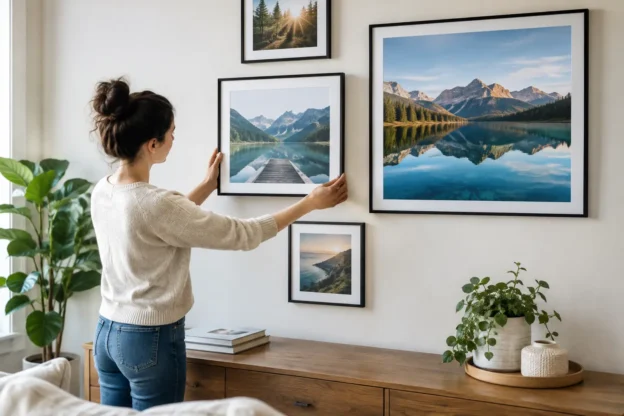
A photograph can look impressive on screen and still disappear once it is placed above a sofa, reception desk or dining table. To choose photographic print sizes well, start with the wall and the viewing distance, not simply the image you like. The right size makes a cityscape, landscape or event photograph feel intentional; the wrong size can leave a strong image looking isolated or overbearing.
For buyers selecting wall art for homes, workplaces or hospitality settings, print size is a practical decision. It affects image crop, frame choice, budget, delivery and the overall balance of the room. A considered approach avoids ordering a print that is technically suitable but visually too small for its setting.
Choose photographic print sizes from the wall first
Measure the usable area rather than the entire wall. Usable space is the clear area around furniture, doors, lamps, switches and other artwork. If a print will sit above a sofa, sideboard or bed, it should generally occupy around two-thirds to three-quarters of the furniture width. This creates a clear relationship between the picture and the item beneath it.
A 180 cm sofa, for example, usually suits a framed print or grouped arrangement between roughly 120 cm and 135 cm wide. A single 30 x 40 cm print would be lost in that space, even if the photograph itself is striking. Conversely, a large panoramic print over a narrow console may make the furniture appear undersized.
Leave breathing room around the artwork. A print placed close to a corner or ceiling can make a room feel cramped. In most settings, hanging the visual centre of the finished framed piece at approximately 145 cm from the floor works well. This may need adjusting in a hallway, above furniture or where viewers are mostly seated.
Match the image to the size and orientation
Not every photograph benefits from enlargement in the same way. Images with a clear focal point, strong detail and a simple composition often work particularly well at larger sizes. A wide London skyline, coastal landscape, transport image or panoramic mountain scene can hold attention across a broad wall. Busy scenes may also work large, provided there is enough detail for viewers to explore from closer range.
Portrait-format prints suit spaces with more vertical than horizontal room. They are useful beside fireplaces, between windows, on stairwells and in narrow entrance halls. Landscapes are often more flexible above furniture, while panoramic formats suit long walls, corridors and meeting rooms.
Consider where the photograph will be viewed. A print in a lounge or hotel lobby is normally seen from several metres away, so it can carry a larger format. In a study, corridor or stairwell, viewers may stand closer and notice fine details more readily. Small prints are effective when viewed at close range, but they need purpose: a bedside wall, a shelf display or part of a planned gallery arrangement.
Cropping matters as much as dimensions
Print dimensions have different aspect ratios. This can change the final composition. A 3:2 image, common in digital photography, fits naturally into formats such as 12 x 18 inches or 20 x 30 inches. A 4:3 image has a different shape, while a square or panoramic image needs a format that respects its original framing.
An 8 x 10 inch print has a more square proportion than a 3:2 photograph. Ordering that size may require trimming from the sides or top and bottom. This is not always a problem, but it can remove a key landmark, part of a subject or valuable foreground detail. Before choosing a format, check the image preview and confirm whether cropping will occur.
For editorial and documentary-style photography, cropping deserves particular care. The placement of people, vehicles, architecture and event details often gives the picture its meaning. If preserving the full scene matters, select a size that follows the original image ratio or use a mount that accommodates the image without excessive trimming.
Use a practical scale guide
There is no universal best print size, but a few working ranges make decisions quicker. Small prints, such as 8 x 10 inches or 20 x 25 cm, work for shelves, compact rooms and grouped displays. Medium prints, around 12 x 16 inches or 30 x 40 cm, suit bedrooms, home offices and smaller wall sections.
Large prints, such as 16 x 20 inches, 20 x 30 inches or 50 x 70 cm, are usually better for feature walls, reception areas and spaces above substantial furniture. For expansive walls, a panoramic format, an oversized single piece or a coordinated set of prints may be more effective than one standard rectangle floating in the middle.
Frames change the finished size considerably. A 50 x 70 cm print with a generous mount and frame can occupy close to 70 x 90 cm on the wall. Measure the external frame dimensions when planning placement, not just the image area. A mount can give a smaller print more presence, but it also introduces more border and may reduce the impact of a detailed photograph.
Think about the room’s purpose
In a home, the image should sit comfortably with the room rather than compete with every other surface. A calm landscape can support a larger format in a living room or bedroom, while a smaller framed travel photograph may add interest to a reading corner. Match the scale to the existing furniture and avoid filling every available wall.
In offices, meeting rooms and reception areas, larger prints are often the more economical visual choice. One well-sized image can establish character without creating a cluttered display. Location-led photography, recognisable city scenes, transport subjects and regional landscapes can also reinforce a business connection to a place.
Hospitality spaces need a slightly different calculation. Guests view artwork while moving through corridors, waiting in reception areas or sitting at tables. Repeated print sizes can bring order to a corridor, whereas a large statement image is more suitable for an entrance, bar or lounge. Choose work that remains legible under the room’s lighting and from the likely viewing distance.
Check image quality before going bigger
A large print requires sufficient image resolution. Enlarging a small file beyond its practical limit can result in soft edges, visible artefacts or a lack of detail. Screen previews do not show this reliably because screens are viewed at a different scale and often make images appear sharper than they will in print.
Ask for confirmation if you are unsure whether an image will suit your required dimensions. Prestige Pictures can provide larger image sizes on request at no extra cost, which is useful when a selected photograph is intended for a prominent print rather than a small standard format. This is especially relevant for panoramic imagery and large wall installations.
The subject itself affects how much resolution is needed. Fine architectural detail, distant crowds, foliage and textural city scenes benefit from larger source files. A misty landscape or image with broad areas of sky may remain visually effective at a larger scale even where micro-detail is less central to the composition.
Decide between one focal print and a grouped display
One large photograph creates a clear focal point and is usually the simplest option for a main wall. It works best when the image has sufficient visual weight and the space needs a confident centrepiece. Panoramic landscapes, dramatic weather, city views and distinctive travel scenes are natural candidates.
A grouped display gives more flexibility where a single large print would be too dominant. Use consistent frame finishes, even spacing and a shared subject or colour direction to keep the arrangement coherent. Prints do not have to be identical sizes, but random dimensions without a plan can look temporary rather than curated.
For a gallery wall, lay out paper templates on the wall before ordering or framing. This reveals whether gaps are too tight, whether the arrangement follows the furniture below, and whether individual images need to be larger. It is a simple check that prevents costly changes after the prints arrive.
Do not treat print size as an afterthought
The most successful choice balances three things: the physical wall, the image proportion and the distance from which people will see it. Budget naturally matters too, but buying too small often creates a second purchase later. It is usually better to choose one properly scaled print than several pieces that fail to establish a presence.
Measure the space, check the crop, allow for the frame and assess the image at its intended viewing distance. Once those decisions are made, the photograph can do what it was chosen to do: bring a specific place, event or moment into the room with the scale it deserves.