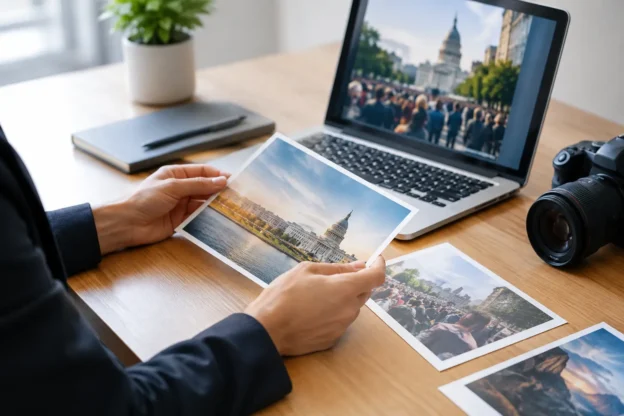
A photograph can carry a news page, establish a location in seconds, or provide the visual proof behind a report. But an image found online is not automatically available for publication. This guide to newspaper photo licensing explains how to source photographs properly, select the right licence, and avoid delays when a story is ready to go to print.
For newspaper publishers, local titles, trade publications and digital newsrooms, the practical question is rarely whether an image looks right. It is whether you have the right to use it in the precise way your publication requires.
What newspaper photo licensing covers
Photo licensing is permission from the copyright holder to use a photograph under stated terms. The photographer, agency or archive retains copyright unless it has been assigned elsewhere. Buying a licence does not usually mean buying ownership of the image.
For a newspaper or news website, the most common requirement is an editorial licence. This permits use in a factual, newsworthy or informational context, such as reporting on a royal engagement, a sporting fixture, a transport disruption, a destination, or a public event. Editorial images can appear in print, on a publication website, within an app, and on social posts promoting the published article, provided those uses are included in the licence terms.
The details matter. A licence may limit the publication to one issue, one article, a defined circulation, a specific territory, or a set time period. Other licences allow broader use across print and digital channels. Read the permitted uses before downloading or placing an image in a layout, particularly if a story may later be syndicated, republished in a supplement, or adapted for marketing.
Editorial use is not promotional use
Newsrooms frequently work at speed, which is why the distinction between editorial and commercial use needs to be clear before commissioning a page.
Editorial use supports reporting, commentary, criticism or factual content. A photograph of a London landmark beside a travel feature, for example, may be editorial where the article discusses the destination. An image from a public ceremony may illustrate reporting on that event.
Commercial or promotional use sells, endorses or advertises something. Using the same London image in an advert for a hotel, a paid campaign for a travel provider, or a banner promoting subscriptions can require a commercial licence. The presence of a logo, recognisable person, private property or protected venue can add further restrictions.
A newspaper’s own promotion creates a grey area. Sharing an editorial article on social media is commonly treated as part of editorial distribution. Lifting the image from that article to advertise a separate product or sponsor campaign is different. Where the purpose changes, check the licence again rather than assuming the original permission carries over.
Choose an image that matches the story
Licensing starts with the image selection itself. A relevant, accurate photograph is less likely to create editorial problems than a generic picture used as a substitute for a specific event.
Captions and metadata should be checked as carefully as the image. Confirm the date, location, people, event and subject shown. A photograph of a previous year’s parade should not be presented as coverage of this year’s parade without a clear archive caption. Equally, a file showing a named venue, aircraft, sporting competition or public figure may have usage notes that affect how it can be published.
For location-based stories, documentary archives can be particularly useful. Images of UK cities, European destinations, transport, military subjects, seasonal scenes and public events offer a clear visual connection to the copy without relying on a loosely related stock concept. Prestige Pictures, for example, provides place-led and event-led imagery that can be sourced by subject when a specific editorial fit is required.
Do not crop or alter an image in a way that changes its meaning. Basic adjustments for sizing, colour balance or page design are often acceptable under standard terms, but removing context, combining images, or creating a misleading impression may not be. Editorial integrity is as relevant as licensing permission.
Check these terms before publishing
The quickest reliable workflow is to confirm the licence before the image is embedded in the page template. Record the image ID, supplier, purchase date, licence type and intended publication. This gives picture editors and production teams a usable audit trail if a question arises later.
Before publishing, check four points:
- The licence permits editorial publication in the required media, including print, website, app and social distribution where needed.
- The planned circulation, territory and duration fall within the licence terms.
- The caption and any required photographer or agency credit are correct.
- The image is not being used to imply endorsement, advertise a product or misrepresent a person, place or event.
If a publication expects an article to remain online indefinitely, do not assume a short-term web licence is sufficient. Likewise, a front-page photograph may need broader print rights than a small image in a regional edition. It depends on the supplier’s terms and the scale of the intended use.
People, property and recognisable brands
Editorial photography can often show recognisable people, logos, buildings and public places without model or property releases, because the image documents a real event or subject of public interest. That does not give a publisher free rein to use the image for advertising.
The context remains decisive. A crowd scene at a public festival used to illustrate a news report is different from the same scene used to promote a product. A portrait of an individual may also call for greater care where the accompanying story is sensitive, critical or unrelated to the person pictured.
Avoid captions that make claims the image does not support. If an image is illustrative rather than a direct record of the event discussed, say so where appropriate. Clear labelling protects readers, subjects and the publication.
Understand rights-managed and royalty-free options
The labels vary between suppliers, but two models appear often in newspaper image buying.
A rights-managed licence is tailored to a defined use. It may specify the publication, placement, print run, territory, size and duration. This can suit a prominent feature, exclusive-style use, or a project where the publisher needs detailed control over how the image is licensed. It can also mean that an additional use requires another licence.
Royalty-free licensing generally permits a wider set of uses for a one-off fee, subject to the supplier’s standard restrictions. It does not mean the image is free, public domain, or available for every conceivable purpose. Editorial-only royalty-free images remain editorial-only, and restrictions on resale, redistribution, misleading use and standalone file sharing still apply.
For busy editorial teams, the best option is usually the one that clearly covers the actual assignment. A pay-per-image library can be useful where image demand is irregular or highly specific. There is no need to maintain a subscription simply to source one archive image for a single feature.
Plan for digital publication and syndication
A printed newspaper has a finite edition. A digital article may be updated, shared, indexed and read years after publication. That difference should shape the licence you choose.
Check whether the licence covers archive access on your website, newsletters, social posts, mobile formats and partner platforms. If a story is supplied to another title, republished by a network, or included in a paid content package, establish whether the original licence allows it. A licence granted to one publisher may not extend to a parent company, contributor, client or syndication partner.
Keep the original licensed file and the associated invoice or confirmation. Sending an unlicensed image file to freelancers, advertisers or third parties can create an unauthorised redistribution problem, even if your own newsroom has permission to publish it.
When to ask before using an image
Ask the supplier before publication if the intended use is unclear, particularly for sponsored content, advertorials, bookazines, cover use, merchandise, large-format display, or a campaign that runs beyond the original article. A short clarification before deadline is easier than replacing a printed page or removing a widely shared digital story.
Also ask when you need a larger file. A high-resolution image may be available for a double-page spread, cover or large display without requiring a different licence, but resolution and usage rights are separate matters. Confirm both rather than treating a larger download as broader permission.
Good image licensing is not paperwork for its own sake. It gives editors the freedom to publish quickly, designers the files they need, and photographers fair control over their work. When the licence, caption and intended use all align, the image can do its job: make the story clearer, stronger and ready for publication.